M8 and M12 connectors are both widely used in industrial automation, robotics, and sensor systems, but they differ in size, performance, and the types of applications they are suited for. While both connectors are circular and threaded, they serve different purposes based on the power and signal requirements of the system.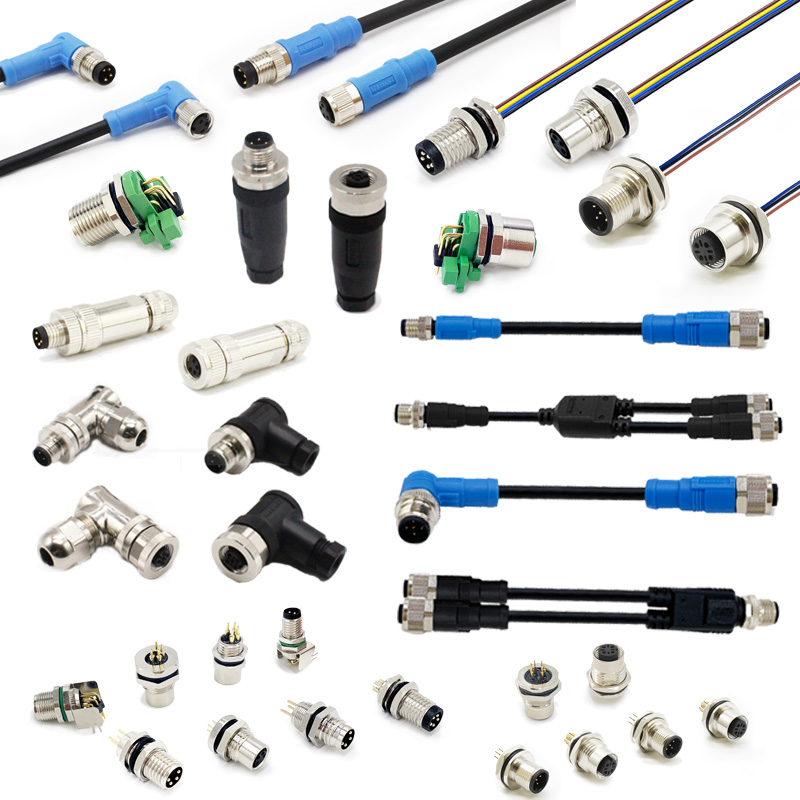
Size and Form Factor: The most obvious difference between M8 and M12 connectors is their size. M8 connectors have an 8mm thread size, while M12 connectors have a 12mm thread size. The smaller size of M8 connectors makes them ideal for applications where space is limited, such as in compact sensor networks or tight machinery enclosures. M12 connectors, being larger, are more robust and can handle higher power and data transmission needs.
Pin Configurations: M12 connectors offer a wider variety of pin configurations, typically ranging from 3 to 12 pins, whereas M8 connectors usually come in 3, 4, or 5-pin versions. This makes M12 connectors more versatile in terms of handling complex wiring configurations, such as in Ethernet-based communication systems or power distribution networks. The higher pin count in M12 connectors allows for the transmission of more signals or power through a single connection.
Power and Data Transmission: M12 connectors are often used for applications requiring higher current and voltage ratings compared to M8 connectors. For instance, M12 connectors are commonly used in Ethernet, CAN bus, and PROFIBUS systems, where they are responsible for high-speed data transmission. M8 connectors, on the other hand, are more suited for smaller sensors and actuators that have lower power and data requirements.
Environmental Protection: Both M8 and M12 connectors can come with high ingress protection (IP) ratings, such as IP67 or IP68, which means they are resistant to dust and water. However, M12 connectors tend to offer better durability in harsh environments due to their larger size and more robust construction. In applications where the connector is exposed to vibration, moisture, or chemical exposure, M12 connectors may provide a more reliable solution.
Application Suitability: M8 connectors are typically used in applications such as proximity sensors, photoelectric sensors, and small actuators, where the power and signal requirements are lower. They are popular in robotics and machine vision systems where compact size is important. M12 connectors, with their higher power capacity and data transmission capabilities, are used in more demanding applications such as industrial Ethernet networks, power distribution, and factory automation systems.
In summary, while both M8 and M12 connectors are essential in industrial automation, M12 connectors are better suited for applications requiring higher power, more complex signal transmission, and greater environmental protection. M8 connectors, on the other hand, are ideal for applications where space is at a premium and the power and data requirements are lower.


