The design of the energy storage plug is a high integration of safety, functionality and durability, aiming to ensure efficient and safe power transmission. Its structure prioritizes electrical protection, high current carrying capacity and heat dissipation optimization, while ensuring long-term reliability through anti-misplugging design and anti-vibration materials.
The design of the energy storage plug is a high integration of safety, functionality and durability, aiming to ensure efficient and safe power transmission. Its structure prioritizes electrical protection, high current carrying capacity and heat dissipation optimization, while ensuring long-term reliability through anti-misplugging design and anti-vibration materials. For different application scenarios, the design will focus on specific needs - for example, outdoor energy storage emphasizes IP68 waterproofing, industrial systems pursue high-power compatibility, and portable devices focus on lightweight and quick plug-in.
1. Selection points
1) Parameter matching:
Confirm that the plug specifications are consistent with the device interface, including the shape, number and arrangement of the pins. For example: a 60A energy storage plug needs to match a 60A interface, and a 350A needs to correspond to a higher specification.
2) Environmental adaptability:
Choose the protection level (such as IP67 waterproof level) and insulation level (such as 1000VAC) according to the usage scenario.
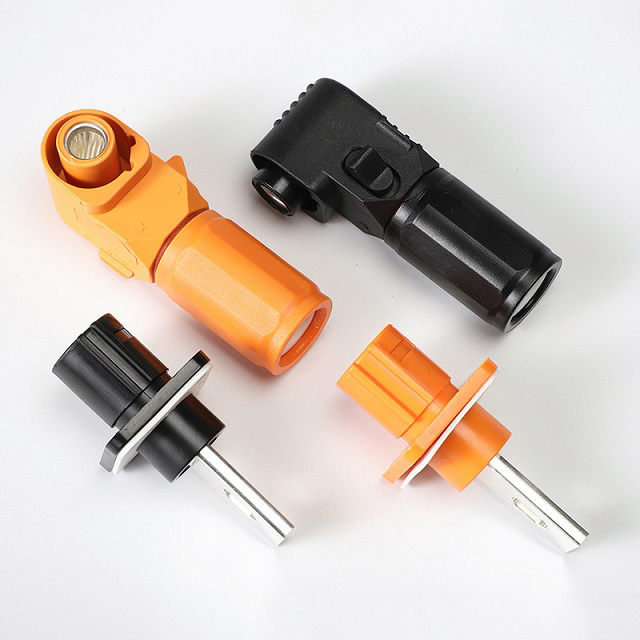 2. Design points
1) Structural safety:
①Use anti-slip handles and rounded corners to improve grip stability and reduce collision risks.
②The inner tube and the outer tube adopt a concentric step structure to ensure that there is no looseness or over-tightening after locking.
2) Ergonomics:
①Add anti-slip texture or concave-convex structure on the surface to facilitate plug-in and unplug operations.
②Eye-catching colors such as orange form visual coordination with the equipment.
3) Heat dissipation design:
Material selection (such as high-conductivity copper) and structural optimization to ensure timely heat dissipation.
3. Installation points
1) Physical installation:
① Connect the wires correctly according to the equipment manual to ensure good grounding.
② Use professional tools (such as socket tester) to verify the power-on status.
2) Protective measures:
① The waterproof cover needs to be installed in a sealed manner to prevent dust and moisture from entering.
② Disconnect the power supply when not in use for a long time to avoid overheating.
4. Other precautions
1) Compatibility test: Different brands of equipment must pass compatibility tests to avoid malfunctions caused by poor contact.
2) Standard compliance: The design must comply with national electrical safety standards (such as GB/T 4026).


