A highly humanoid robot may have more than 40 joints throughout its body, plus dozens of sensors and actuators in its hands, requiring hundreds or even thousands of connectors. As the production of humanoid robots increases, the demand for connectors will grow exponentially.
Core "Brain" and "Neural Center": Main Control and Communication
This area is equivalent to the robot's head and main torso structure, responsible for high-speed data processing and overall coordination.
1) Board-to-Board Connectors:
Function: Connects the main board to sub-boards such as coprocessors, sensor modules, and memory. This is the most densely packed connection within the robot.
Requirements: Ultra-high density (pin spacing as small as 0.2mm-0.4mm), low height (to save space), and excellent vibration resistance.
Application Location: Inside the main controller.
2) FPC/FFC Connectors:
Function: Connects flexible circuit boards for applications where space is limited and bending is required.
Requirements: Ultra-thin, lightweight, and with a strong unlocking force to prevent accidental detachment.
Application Location: Connects camera modules, displays (if any), and sensors within the neck or torso.
3) High-Speed Data Transmission Connectors:
Function: Transmits high-speed serial data generated by cameras, LiDAR, etc.
Requirements: Supports high-speed protocols (such as MIPI CSI-2, USB 3.0/3.1, Ethernet).
Application Location: Connection between the head vision system and the motherboard.
4) Fiber Optic Connector:
Function: Transmits extremely high bandwidth data in complex electromagnetic environments or over long distances; may replace some copper cables in the future.
Requirements: Miniaturization, high precision.
Application Location: Backbone data link.
"Limbs" and "Joints": Actuation and Power
This is the core of robot movement, requiring the highest power and reliability from connectors.
1) High-Current Connector:
Function: Provides power to the motors (joint modules) at the joints. One of the most critical connectors for humanoid robots.
Requirements: High current carrying capacity (typically above 10A, even tens of amperes), low contact resistance, vibration-resistant design (prevents loosening due to robot movement), high mating life.
Application Location: Major joints such as the shoulder, elbow, hip, and knee.
2) Servo Motor Feedback Connector:
Function: Connects the encoder (absolute/incremental) inside the motor, feeding back position and speed signals to the controller.
Requirements: Multi-core (transmits power, differential signals), high reliability, and good shielding to resist electromagnetic interference generated by the motor.
Application Location: Each joint motor.
3) Hybrid Connector:
Function: Integrates power, signal, and data lines into a single connector housing. This is an important future trend, simplifying wiring, saving space, and improving reliability.
Requirements: Modular design, allowing customization of the number and layout of power and signal contacts.
Application Location: Integrated joint modules, enabling "plug and play".
"Sensory" System: Perception and Feedback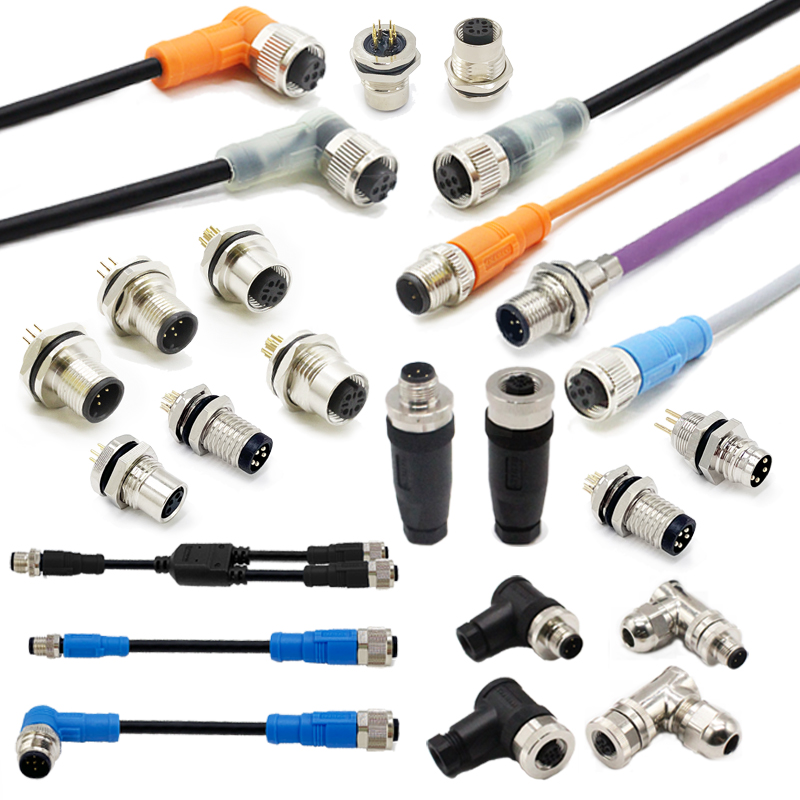
For the robot's environmental perception, connectors need to handle minute signals and complex environments.
1) Miniature Circular Connector:
Function: Connects various distributed sensors, such as force/torque sensors, tactile sensors, temperature sensors, etc.
Requirements: Miniaturization (e.g., M5, M8 specifications), high sealing rating (e.g., IP67/IP68, dustproof and waterproof), robust housing.
Applications: Wrist, ankle (six-dimensional force sensor), fingertip (tactile sensor).
2) Board-to-Wire Connectors:
Function: Connects wiring harnesses to various sensor boards and controllers.
Requirements: Diverse types, from precision pin headers/female headers to locking wire-to-board connectors, all requiring good contact retention and polarization design (to prevent mis-mating).
3) Coaxial Connectors:
Function: Connects antennas for wireless communication such as Wi-Fi, Bluetooth, and 5G.
Requirements: Miniaturization (e.g., IPEX interface), stable RF performance.
"Body" and "Energy": Power Supply and Structure
1) High-Voltage, High-Current Power Connector:
Function: Connects the main battery pack, powering the entire robot.
Requirements: Extremely high current and voltage capacity, arc protection design, and secondary locking mechanism for safety.
Application Location: Battery interface within the robot's torso.
2) Battery Management System Connector:
Function: Connects voltage and temperature acquisition lines between battery modules.
Requirements: High precision, high reliability.
| Parts |
Key Connector Type |
Core Requirements |
| Brain/Central System |
Board-to-board, FPC, High-speed data |
High density, high frequency and high speed |
| Limbs/Joints |
High current, motor feedback, hybrid type |
High power, vibration resistance, high reliability |
| Sensory System |
Miniature circular, board-to-wire |
Miniaturization, hermeticity |
| Tortoise/Energy |
High voltage power supply, BMS |
High power, safety |
1) From Discrete to Integrated: Hybrid connectors will become mainstream, reducing connection points and improving system reliability.
2) Extreme Miniaturization: As robot structures become more compact, connector spacing will continue to shrink, placing extremely high demands on manufacturing precision.
3) Material Revolution: Utilizing lighter, stronger composite material shells and higher-performance contact coatings.
4) Intelligence: Connectors may integrate diagnostic functions, such as monitoring temperature, humidity, and mating cycles, enabling predictive maintenance.
In conclusion, humanoid robots are pushing the limits of existing connector performance and driving innovation and development in next-generation connector technologies. Manufacturers capable of providing the high-performance, high-reliability connector solutions described above will occupy a core position in the future humanoid robot industry chain.
Contact us for catalogs and quotations for related sensor connectors.


