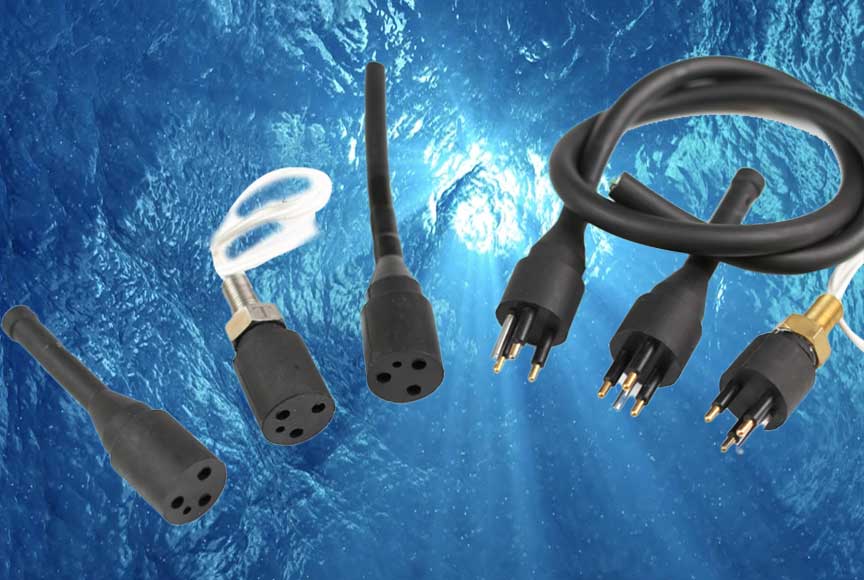
The environment in which underwater connectors are deployed has a significant influence on their design and material selection. Underwater environments are highly variable and can pose a range of challenges, including exposure to saltwater, high pressure, temperature fluctuations, and biological growth. Here’s how environmental factors affect the design and materials used in underwater connectors:
Saltwater and Corrosion:
Saltwater is highly corrosive, particularly to metals. To combat this, underwater connectors are often made from corrosion-resistant materials such as stainless steel, titanium, or specialized alloys like nickel-aluminum bronze. These materials are chosen for their ability to resist the corrosive effects of saltwater over long periods. In some cases, connectors may be coated with anti-corrosive materials, such as Teflon, to provide an additional layer of protection.
Water pressure increases significantly with depth, placing considerable stress on underwater connectors. Connectors used in deep-sea applications must be able to withstand these pressures without failing. To address this, deep-sea connectors are designed with pressure-resistant housings made from robust materials like titanium or high-strength polymers. These materials are selected for their ability to endure the intense pressures found in deep-sea environments, such as those encountered by ROVs and submersible vehicles.
Underwater environments can experience wide temperature variations, especially in polar regions or deep ocean settings. Connectors must be able to function in both extremely cold and relatively warm waters. Thermoplastics and elastomers are often used in the connector’s sealing mechanisms because they maintain flexibility and integrity over a wide temperature range. For extreme cold environments, such as those in Antarctic exploration, materials with low thermal expansion coefficients are selected to prevent cracking or loss of seal integrity.
Marine environments are home to a wide range of biological organisms that can grow on submerged surfaces, a phenomenon known as biofouling. Over time, organisms like barnacles, algae, and other marine life can accumulate on connectors, potentially affecting their performance. To prevent biofouling, connectors may be treated with anti-fouling coatings or materials that are resistant to biological growth. Copper-based alloys are commonly used in some underwater connectors because copper naturally inhibits the growth of marine organisms.
Underwater connectors are often exposed to mechanical wear and tear from strong currents, underwater equipment, or interactions with marine life. Materials such as hardened plastics or reinforced elastomers are used to ensure the connectors can withstand repeated mechanical stress. Locking mechanisms are also integrated into many connectors to prevent accidental disconnection due to vibration or movement in the water.
In some underwater environments, connectors may be exposed to chemicals such as oils, fuels, or industrial pollutants. In these cases, connectors are designed with chemical-resistant materials that can withstand exposure to harsh substances without degrading. For example, connectors used in offshore oil platforms or subsea drilling equipment must be resistant to both the marine environment and the chemicals used in the drilling process.
In conclusion, the underwater environment imposes specific requirements on the design and material selection of connectors. Factors such as corrosion resistance, pressure tolerance, temperature resilience, biofouling prevention, and mechanical durability must all be considered when designing underwater connectors. The use of specialized materials and coatings ensures that connectors can perform reliably in even the most challenging underwater conditions.