In an era defined by interconnected technologies, cable connectors serve as the critical, yet often overlooked, components that enable our world to function. More than simple linking devices, they are sophisticated interfaces engineered to ensure the seamless, reliable, and safe transmission of data, audio, video, and power across a vast array of devices and systems. As the backbone of our intricate communication networks and electrical infrastructure, the design and application of cable connect
In an era defined by interconnected technologies, cable connectors serve as the critical, yet often overlooked, components that enable our world to function. More than simple linking devices, they are sophisticated interfaces engineered to ensure the seamless, reliable, and safe transmission of data, audio, video, and power across a vast array of devices and systems. As the backbone of our intricate communication networks and electrical infrastructure, the design and application of cable connectors directly influence system performance, safety, and longevity.
The Primary Function: Ensuring Signal Integrity and Power Continuity
The fundamental purpose of any cable connector is to establish a secure, stable, and low-resistance junction between cables or between a cable and a device. This objective is multifaceted, addressing several key challenges in signal and power transmission:
1) Maintaining Signal Clarity: Connectors are designed to minimize signal attenuation and reflection. Poorly designed connectors can act as bottlenecks, causing data packets to drop, video signals to degrade, or audio to become noisy. High-quality connectors preserve signal strength and integrity from source to destination.
2) Preventing Interference: In environments saturated with electromagnetic interference (EMI) and radio-frequency interference (RFI), connectors—especially shielded types like RF coaxial or metal-shell D-Sub connectors—create a protective barrier. This shielding prevents external "noise" from corrupting the signal and contains emissions from the cable itself.
3) Ensuring Physical Stability: A connector must maintain a mechanically robust connection resistant to vibration, accidental tugs, and environmental stress. Locking mechanisms (threaded, latch, or push-pull) are critical in industrial, automotive, and mobile applications to prevent disconnection that could lead to system failure or data loss.
4) Providing Environmental Sealing: For outdoor, automotive, or harsh industrial use, connectors with IP (Ingress Protection) ratings (e.g., IP67, IP68) are essential. They prevent the ingress of dust, moisture, and chemicals, which can cause short circuits, corrosion, and permanent damage.
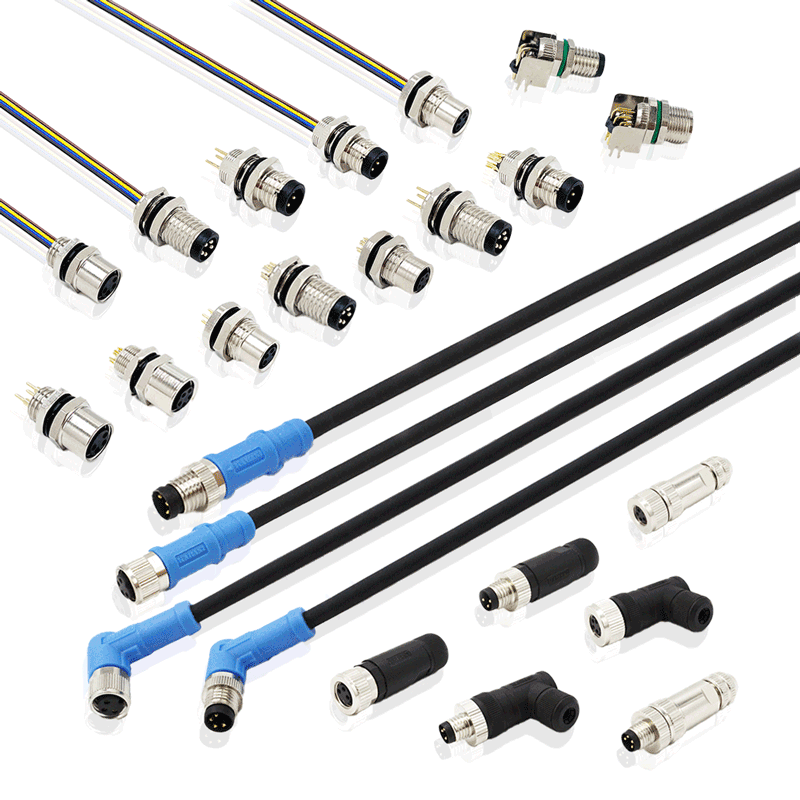
A Diverse Ecosystem: Key Types of Cable Connectors and Their Applications
The diversity of connectors corresponds directly to the variety of signals they carry. Selecting the correct type is paramount for optimal system function.
1) Fiber Optic Connectors: Used for joining optical fibers with extreme precision. Types like LC, SC, and MPO are staples in high-speed data centers, telecommunications backbones, and broadband networks. They enable the transmission of vast amounts of data over long distances with minimal loss and immunity to EMI.
2) Audio and Video Connectors: This broad category facilitates media connectivity.
- Audio: XLR connectors provide balanced audio for professional microphones and equipment, while TRS (¼") and 3.5mm jacks are standard for headphones and consumer audio.
- Video/AV: HDMI and DisplayPort transmit digital high-definition video and audio. BNC connectors are used for professional broadcast video and RF applications.
3) Data & Network Connectors: The foundation of digital communication.
- RJ45 is the universal standard for Ethernet (CAT5e, CAT6, and CAT6a) networking.
- USB (A, B, C, Micro) provides serial data transfer and power for peripherals.
- D-sub (e.g., VGA, serial ports) and modular fieldbus connectors (M12, M8) are crucial for industrial automation and control systems.
4) RF Coaxial Connectors: Designed for radio frequency signals, connectors like SMA, N-Type, and TNC are essential in wireless communications, GPS, cellular infrastructure, and test equipment.
5) Power Connectors: Responsible for safely delivering electrical energy.
- IEC 60320 (C13/C14) is a standard for desktop electronics.
- Heavy-duty AC power connectors (IEC 60309) are used in industrial machinery.
- DC power connectors (barrel jacks, terminal blocks) power a wide range of devices from routers to control panels.
The Critical Safety Function: Protecting People and Equipment
Beyond performance, cable connectors are fundamental to electrical safety. They are engineered to prevent accidents and protect infrastructure.
1) User Protection: Connectors prevent accidental contact with live conductors. Features like insulated housings, shrouded pins, and touch-proof designs are crucial in preventing electric shock or arc flash incidents.
2) Equipment Protection: By providing a secure and correct mating interface, connectors prevent miswiring, short circuits, and overvoltage events that can damage sensitive and expensive electronics. Polarized designs ensure they can only be connected in the correct orientation.
3) Cable Strain Relief: Integrated strain relief features prevent tension on the cable from being transferred directly to the delicate electrical terminations inside the connector, thereby extending cable life and preventing wire breakage.
4) Compliance with Standards: Reputable connectors are designed and tested to meet stringent international safety standards (e.g., UL, CSA, CE, IEC), assuring their performance and safety in defined applications.
Conclusion: The Indispensable Link in a Connected World
From streaming high-definition video in our homes to controlling automated manufacturing lines and forming the global internet's physical layer, cable connectors are indispensable. They are the unsung heroes who ensure clarity in our communications, reliability in our power systems, and safety in our interactions with technology. As data rates climb, power demands increase, and environments become more challenging, the innovation in connector technology—focusing on higher bandwidth, greater density, and robust durability—will continue to be a primary enabler of technological progress. Choosing the right connector is not merely a technical detail; it is a foundational decision for the stability and success of any electrical or communication system.


