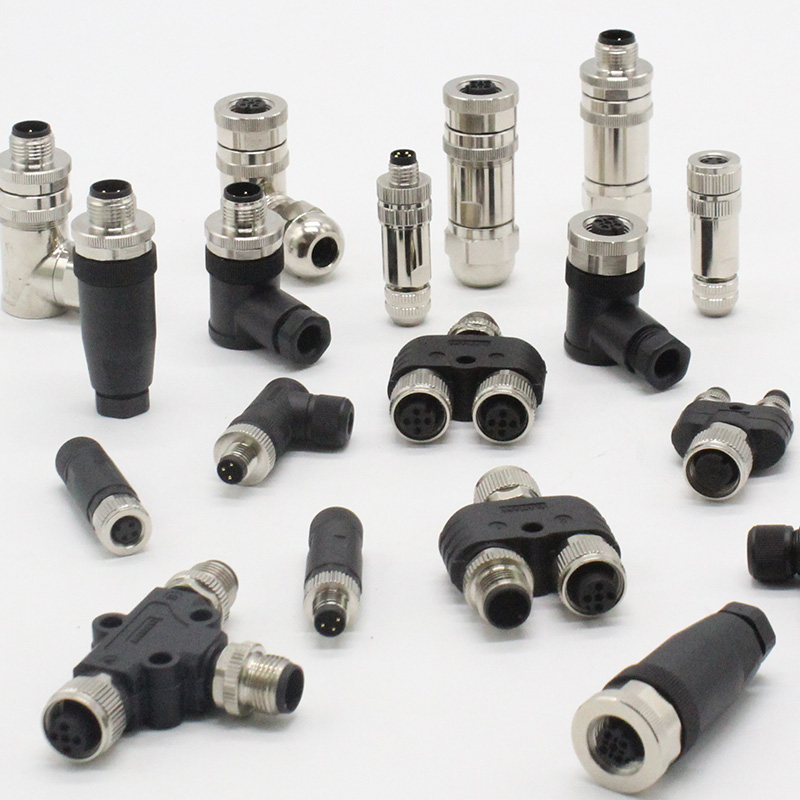
M8 connectors can be classified according to the number of pins, protection level, signal type, cable material and special functions.
The M8 connector is a compact circular connector widely used in industrial automation, sensors, actuators and other fields. It is named for its 8 mm diameter threaded interface. The following are its common classifications and typical application scenarios:
Classification
I. Classification by number of pins
1) 3-pin M8 connector
- Application: digital signal transmission (such as PNP/NPN sensors, photoelectric switches)
- Example: Omron E2E proximity switch, Pepperl+Fuchs photoelectric sensor
2) 4-pin M8 connector
①Analog signal (4-20mA/0-10V)
②IO-Link communication (supports bidirectional data exchange)
- Case: Distributed I/O module connection of Siemens S7-1200 PLC
3) 5-pin M8 connector
- Application:
①Industrial Ethernet (such as Profinet, EtherNet/IP)
②Differential signal transmission with shielding layer
4) 8-pin M8 connector
- Application: multi-channel signal integration (such as servo motor encoder feedback)
II. Classification by protection level
1) IP67/IP68 level
- Features: waterproof and dustproof, resistant to high-pressure washing
- Scenario: food processing machinery, outdoor AGV charging interface
2) IP69K level
- Features: resistant to high-temperature steam cleaning (up to 80°C)
- Scenario: pharmaceutical equipment, automotive paint shop
III. Classification by signal type
1) Power type (high current)
- Parameters: 4A@250V AC (such as Harting Han® M8 Power)
- Use: small motor power supply, valve coil drive
2) Signal type (high speed)
- Parameters: 100MHz bandwidth (such as Molex Brad® M8 D-Code)
- Application: industrial camera, laser radar data transmission
3) Hybrid (power + signal)
- Design: split structure (such as 3-pin power + 2-pin signal)
- Application: integrated connection of intelligent actuators
IV. Classification by cable type
1) PVC cable
- Applicable: conventional industrial environment (-25℃~80℃)
2) PUR cable
- Features: oil resistance, chemical corrosion resistance
- Scenario: machine tool hydraulic system, petrochemical equipment
3) TPE cable
- Advantage: high flexibility (>5 million bending life)
- Application: robot seventh axis drag chain system
V. Special function type
1) With shielding layer
- Function: anti-EMI interference (such as CAN bus connection)
- Standard: in accordance with EN 61076-2-104
2) Push-Pull
- Advantage: one-handed operation, anti-mis-removal design
- Scenario: mobile medical equipment, detachable instruments and meters
3) High temperature type
- Temperature resistance: -40℃~125℃ (such as TE Connectivity M8 S series)
- Applications: engine compartment sensor, metallurgical equipment
Typical industry applications
1) Industrial automation
- Electrical interface of end-of-arm tool (EOAT)
- Cascade wiring of conveyor line photoelectric sensor
2) Automobile manufacturing
- Battery module voltage detection harness (high voltage version)
- Tire pressure monitoring system (TPMS) signal transmission
3) Rail transit
- Redundant connection of door control unit (DCU)
- Waterproof connector of track signal light
4) New energy
- Photovoltaic inverter DC side connection
- Charging pile gun head temperature sensor interface
Key selection parameters
1) Electrical performance:
voltage/current capacity, contact resistance (usually <10mΩ)
2) Mechanical life:
plug-in and unplug times (industrial grade ≥500 times, automotive grade ≥1,000 times)
3) Certification standards:
UL 1977, IEC 61076-2-104, AEC-Q200 (automotive)
4) Wiring method:
welding/crimping/spring clamping (tool-free crimping technology is recommended)