There are differences between M5 and M12 connectors in size, application scenarios and electrical characteristics. When choosing, you need to match them according to actual needs (such as space restrictions, voltage levels, signal types, etc.).
There are differences between M5 and M12 connectors in size, application scenarios and electrical characteristics. When choosing, you need to match them according to actual needs (such as space restrictions, voltage levels, signal types, etc.).
Size and Volume
- M5: Small size, suitable for space-constrained application scenarios, such as precision instruments or embedded devices.
- M12: Large external thread diameter and significant volume, suitable for industrial environments that require stronger mechanical support or higher current transmission.
Voltage and Current Carrying Capacity
- M5: Small pin spacing, only suitable for low voltage scenarios below 50V AC or 60V DC, cannot meet high voltage requirements.
- M12: Can handle up to 16V voltage, suitable for high voltage applications in industrial environments, and complies with IEC-61076-2-101 standard.
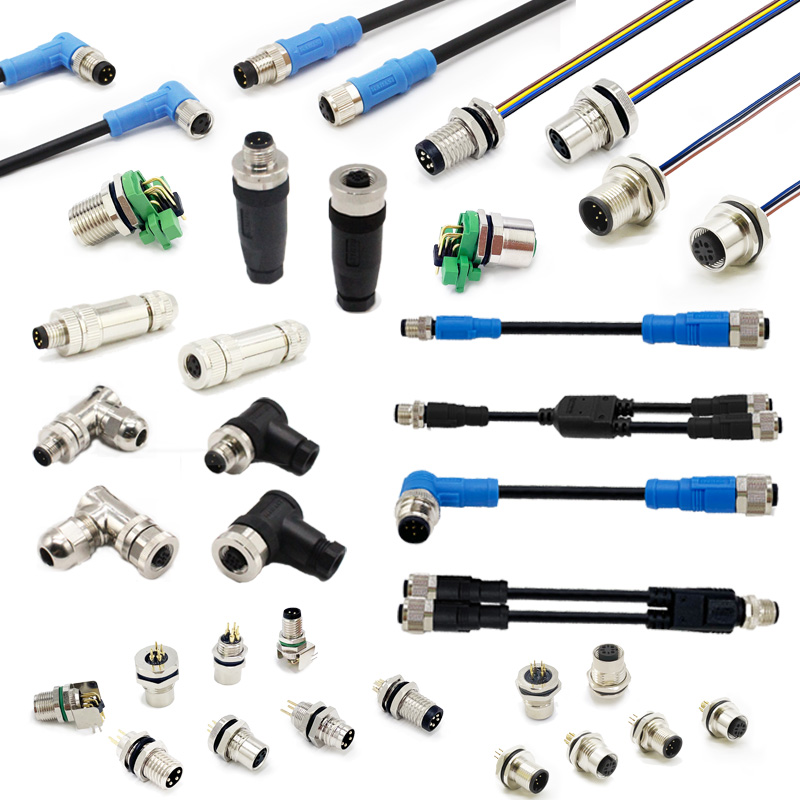
Signal Type and Encoding
- M5: Usually uses a single encoding (such as A encoding), mainly used for DC transmission, such as sensor signal interface.
- M12: Supports multiple codes (A, B, C, D, K), for example:
A code: 24VDC, sensor signal interface
B code: Profibus, Interbus and other field buses
C code: 24/110/230VAC AC
D code: Profinet, Ethernet, EtherCat and other network communications.
Standards and Compatibility
- M5: No specific international standards are explicitly mentioned, but it belongs to the industrial general-purpose small connector series.
- M12: Strictly follow the IEC-61076-2-101 standard (2012 edition) to ensure interchangeability and interoperability, and support bandwidth requirements up to 10 Gb/s2.
Application
- M5: Mostly used for connecting sensors (such as pressure, position, temperature and humidity sensors) to control systems because of its small size and easy wiring.
- M12: As a mainstream industrial connector, it is widely used in scenarios such as motor drives, PLC interfaces, sensor networks, etc., and undertakes more complex electrical and data transmission requirements.
Pin Function Differences
Different models of M5 and M12 may use different pin allocation schemes. For example, the A/B/C/D/X coded pins of M12 are used for different functions such as DC, sensor signals, AC, Ethernet, etc., while the specific configuration of M5 needs to refer to the specific model standard.


