The selection of copper cable lug needs to comprehensively consider the wire diameter matching, material process and scene characteristics.
The selection of copper cable lug needs to comprehensively consider the wire diameter matching, material process and scene characteristics. Silver-plated sealed models should be preferred in the new energy field, and mechanical strength and corrosion resistance should be emphasized in industrial scenes. It is recommended that enterprises build a selection teaching database, carry out crimping process certification in combination with the IEC61238-1 standard, and conduct regular inspections with infrared thermal imagers to ensure safe and reliable electrical connections.
Special selection requirements for Copper Cable Lug1. High-voltage wiring harness application (such as electric vehicle battery pack)
- Material upgrade: Silver-plated Copper Cable Lug (contact resistance ≤0.5mΩ), temperature resistance -40℃~180℃;
- Protection level: IP67 sealing design, passed QC/T 1067-2023 vibration test standard
2. Photovoltaic system selection
- Weather resistance requirements: select T2 copper + silicone sealing sleeve, and withstand UV ultraviolet aging for 2000 hours;
- Current carrying: The DC side needs to be selected according to a 1.56 times coefficient (such as 20A circuit select 32A model).
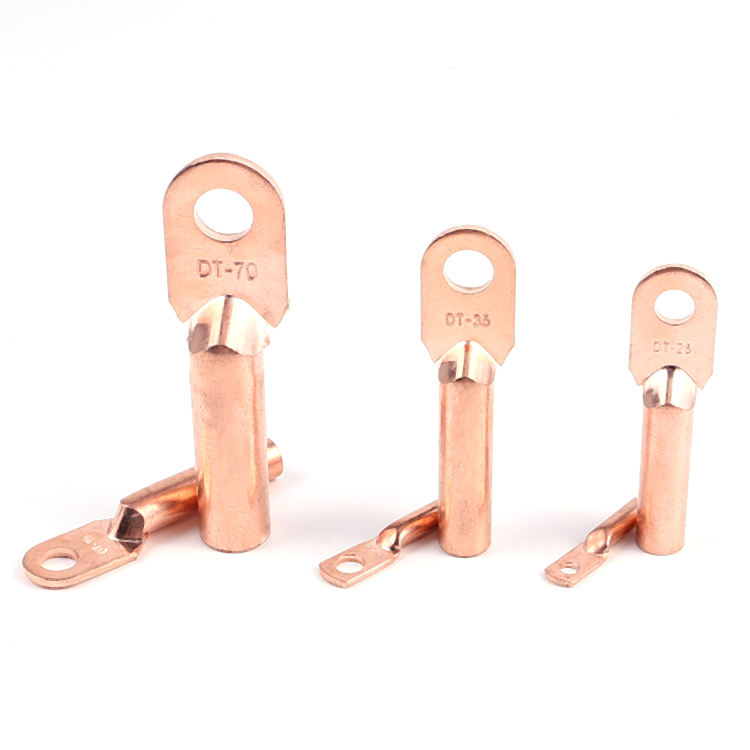
Core principles of selection and common misunderstandings1. Calculation of current carrying capacity
- Formula: l=K*S (K is 5-6A/mm², S is the cross-sectional area of the wire core)
- Example: The current carrying capacity of 35mm²Copper Cable Lug is 175A when K=5, and a 20% safety margin needs to be reserved
2. Common misunderstandings and correction solutions
| Error |
Risk |
Solution |
| The hole diameter does not match the bolt |
Increased contact resistance causes overheating |
Choose a model with a hole diameter 0.2-0.5mm larger than the bolt |
| Molybdenum wire is directly crimped to the copper cable lug |
Electrochemical corrosion causes failure |
Use copper-aluminum transition terminals or tinning |
| Multi-strand wire does not use copper sleeve |
Untight crimping causes sparks |
Cables above 16mm must be equipped with copper sleeves |
1. Crimping process specifications
- Hydraulic pressure:
| Wire diameter (mm²) |
Pressure (tons) |
Number of crimping passes |
| ≤25 |
6-8 |
2 |
| 35-50 |
10-12 |
3 |
- Testing standard: The wire pull-off force after crimping is ≥ 70% of the cable breaking force (GB/T 9327).
2. Quality verification method
- Contact resistance: Four-wire method test, required to be ≤ 1.2 times the resistance of the same length cable
- Temperature rise test: Load rated current for 1 hour, temperature rise ∆T≤55K.
Comparison table of core parameters of specifications and models
| National standard (GB) |
German standard (DIN) |
American standard (AWG) |
Applicable wire diameter (mm²) |
Aperture (mm) |
Rated current (A) |
| DT-10 |
DIN 46235-10 |
AWG 8 |
6-10 |
6.0 |
80-120 |
| DT-16 |
DIN 46235-16 |
AWG 6 |
10-16 |
8.0 |
120-160 |
| DT-25 |
DIN 46235-25 |
AWG 4 |
16-25 |
10.0 |
160-200 |
| DT-35 |
DIN 46235-35 |
AWG 2 |
25-35 |
12.0 |
200-250 |
| DT-50 |
DIN 46235-50 |
AWG 1/0 |
35-50 |
14.0 |
250-315 |


